Breast Lift vs. Breast Augmentation: Which Is Right for Me?
When women consider enhancing their breasts, the two most common procedures are breast augmentation and breast lift (mastopexy). While both can be transformative, they achieve different goals. Many patients find the choices confusing and have a reluctance toward undergoing a breast lift. The right choice depends on your anatomy, goals, and tolerance for certain tradeoffs.
Breast Augmentation: Adding Volume and Shape
Breast augmentation increases breast volume with implants and can improve fullness, cleavage, and overall size. The implant can be placed under the muscle (submuscular or subpectoral), over the muscle (subglandular), or in the subfascial plane, which is the layer beneath the fascia that covers the chest muscle but above the muscle fibers themselves.
Subfascial Augmentation: A Hybrid Approach
Subfascial augmentation is a technique where the implant sits beneath the thin but strong layer of fascia that naturally covers the pectoralis muscle. This position:
-
Separates the breast gland from the implant, providing a functional barrier between the breast tissue and ducts from the implant itself.
-
Provides more implant coverage than subglandular placement, reducing visible rippling or edges.
-
Eliminates animation deformity (distortion of the implant with chest muscle movement), which is common with submuscular placement.
-
Can create a mild “mini-lift” effect in patients with mild sagging and good skin elasticity. The implant pushes the breast tissue forward and upward slightly, improving nipple position without formal lift scars.
What About Capsular Contracture?
Traditionally, one of the biggest concerns about implants placed above the muscle (subglandular or subfascial) was a higher rate of capsular contracture, which is the tightening of scar tissue around the implant that can make breasts feel hard or distorted.
However, newer data with advanced implants such as Motiva Ergonomix and Motiva Round show very low capsular contracture rates even in the subfascial plane. These implants have:
-
Nanotextured surfaces designed to reduce inflammation and scar formation.
-
Lower rupture and complication rates compared to older generations of implants.
This means patients can benefit from the natural look, subtle lift, and reduced muscle interference of subfascial augmentation without the higher capsular contracture risk that once made surgeons cautious about this technique.
Breast Lift (Mastopexy): Restoring Position and Shape
A breast lift removes extra skin, reshapes the breast tissue, and repositions the nipple and areola higher on the chest. It’s ideal when breasts sag, nipples point downward, or the areola has stretched.
The Scar Question
The most common hesitation about a breast lift is scarring. Depending on the degree of lift needed, incisions can be: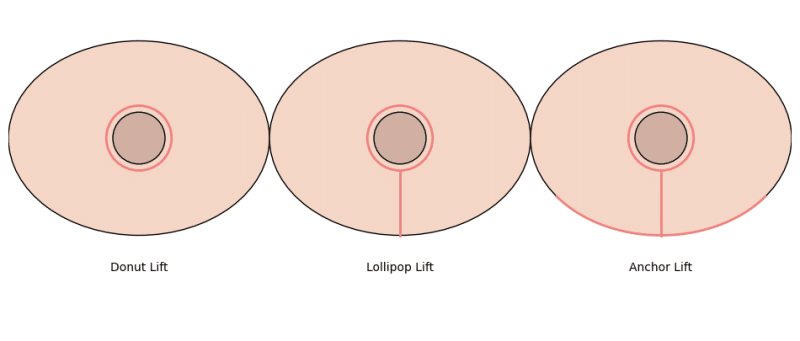
-
Around the areola only (“donut” or circumareolar lift)
-
Around the areola plus vertically down to the fold (“lollipop” or circumvertical lift)
-
Around the areola, vertically down, and along the fold (“anchor” or Wise-pattern lift)
These scars are real, but in most patients they fade dramatically within a year and are easily hidden in bras and swimsuits. For women with significant sagging, the trade-off is worth it: perkier, youthful breasts at the cost of a fine line scar.
Combining Augmentation and Lift
When patients want both volume and elevation, an augmentation-mastopexy (otherwise known as “aug-pexy”) is the best option. This combines the benefits of implants with surgical lifting, producing fuller, perkier breasts in one procedure.
How to Decide
-
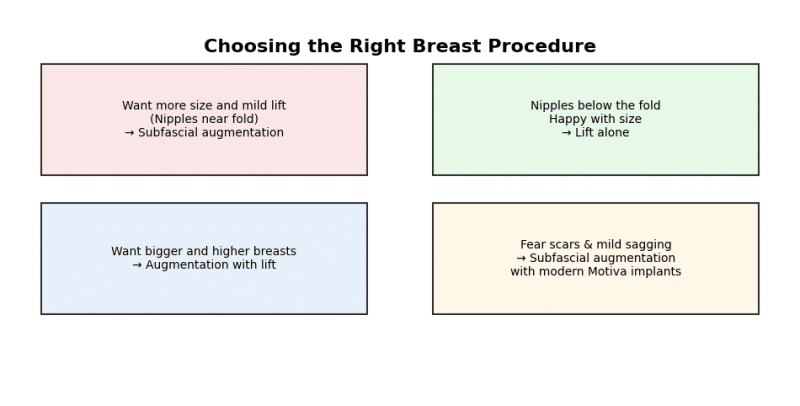
If you want more size and mild lift, and your nipples are near the fold: Subfascial augmentation may be ideal.
-
If your nipples are below the fold and you’re happy with size: A lift alone is likely needed.
-
If you want both bigger and higher breasts: Augmentation with lift gives the most complete transformation.
-
If you fear scars but only have mild sagging: Subfascial augmentation with modern implants like Motiva can offer a scar-sparing solution with low capsular contracture risk.
Final Thoughts
The decision between breast lift and augmentation can be complicated. Subfascial augmentation has expanded the options for women with mild sagging, offering natural results with low complication rates, especially when paired with advanced implants like Motiva. For those with more significant droop, a lift (with or without implants) provides the best reshaping.
The right procedure depends on your anatomy and goals. Contact us if you would like to clarify the best path forward and design a plan tailored specifically to you.